
|
Creation Calendar
The Creation Calendar shows Hebrew 








Isaiah 53 from the Aleppo Codex













Welcome to Torahcalendar.com
The Calendar Restoration Project is a historical work in progress to restore the Creation Calendar of Scripture.
Based on the whole counsel of Scripture, it is evident that the Creation Calendar is a 7000 year calendar modeled
on the seven days of creation. It is composed of 140 Jubilee Cycles of 50 years.
From Psalm 90:4 and 2 Peter 3:8, the Scriptures teach that the Seventh Millennium, which is the Millennial Sabbath and the Age of Life with יהושע Messiah, will begin after 6000 Years since the true epoch of creation. We believe the Sabbaths, New Moons, Appointed Times and Festivals of יהוה have been correctly restored. We also believe that this site correctly teaches how to determine the Hebrew Hour, Hebrew Day, Hebrew Month and Hebrew Year. We are watching, hoping, and praying that the Messiah will come soon. The final goal of the Calendar Restoration Project is to successfully determine the true epoch of creation. יהושע Messiah is not delaying His coming, but will come on time at the restoration of all things as prophesied by Peter in Acts 3:21. We must all keep watching as the Master has said, to see something many have longed to see - the resurrection of the just. By entering this website you acknowledge that the date posted for the epoch of creation is provisional, and is conditional upon historical proof which is not yet published. Certain very ancient historical dates before Moses which are provided in articles on this site should still be considered provisional at this time. 
Using the Creation CalendarThe duration of the Creation Calendar is 7000 years. This website can currently display Hebrew Months for any year within a theoretical range from 3980 B.C.E. to 3035 C.E. Use the navigation box located at the top of this page to view Hebrew Months on the Creation Calendar. There are two ways to access months. Enter a Gregorian/Julian calendar date (Day, Month, Year) to go to the Hebrew Month in which that date is found, or directly select a Hebrew Month and a Gregorian/Julian year. The abbreviation C.E. means Common Era and B.C.E. means Before Common Era. Click on B.C.E to access years before 1 C.E. Spiritual Years begin in the spring around March or April on the Gregorian/Julian calendar, and Hebrew Months are numbered from the beginning of the Spiritual Year. The navigation box utililizes Gregorian/Julian years and Hebrew Months. The convention chosen to identify Spiritual Years on this website is to use the corresponding Gregorian/Julian year in which the Spiritual Year begins. 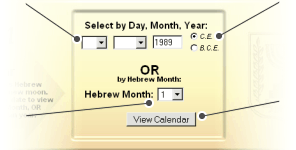
Gregorian or Julian Date
If you know a Gregorian/Julian Select by Hebrew Month
If you know which Hebrew Month C.E. and B.C.E. Buttons
Select C.E. for Gregorian/Julian years View Calendar Button
Once you have selected either a The Calendar PageAfter pressing the View Calendar button, a calendar page appears displaying the selected Hebrew Month. The sample calendar page below shows Hebrew Month 1 which occurred in 1989 C.E. on the Gregorian Calendar. This example will be used to demonstrate helpful features of the Creation Calendar. 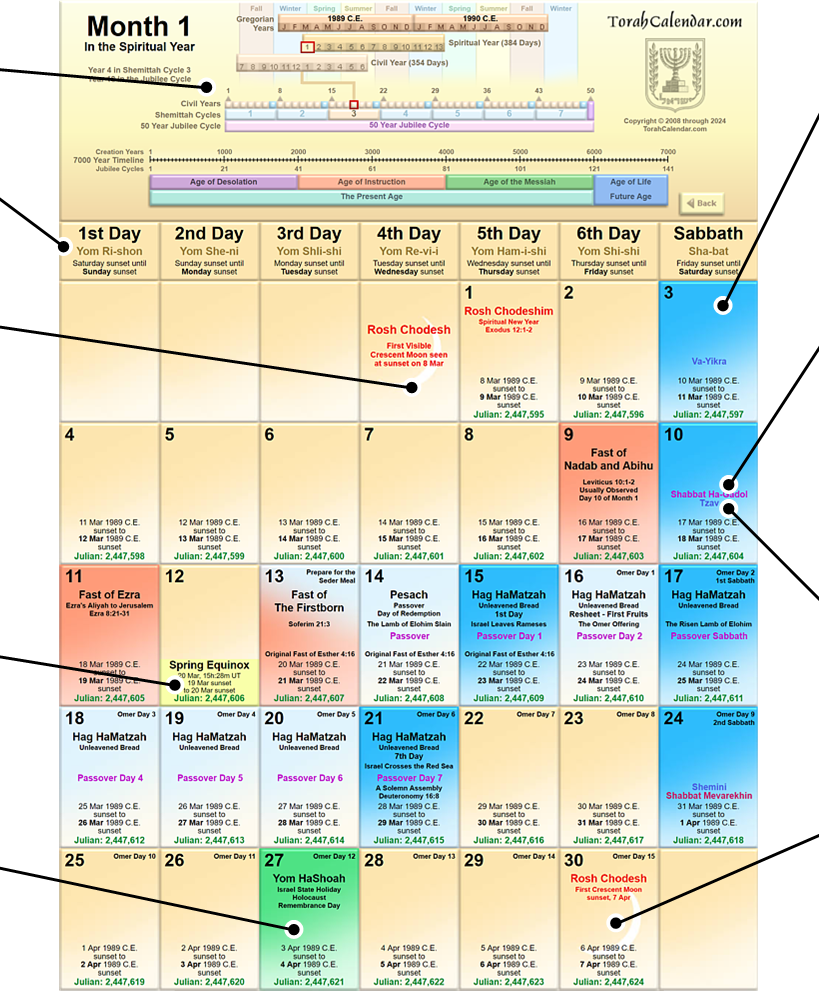
Month Header (See detail below) Week Day Header
Shows the Hebrew names New Moon Day
Months begin at sundown Seasons Change
A yellow rectangle at the Special Days
Colors other than tan Sabbath Days
All the Sabbaths of
יהוה
Special Readings
Names in red and Parashah Reading
Hebrew names in blue Rosh Chodesh
Hebrew Months usually The Month Header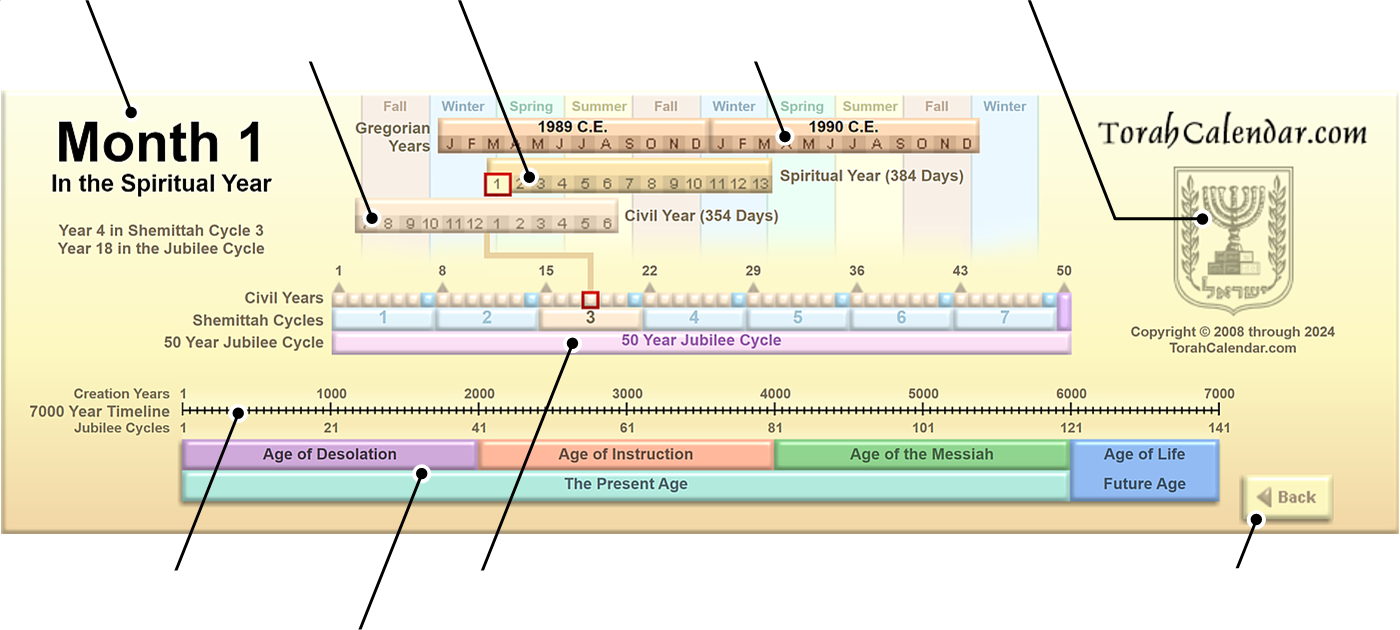
Hebrew Month Seal of Israel (Home Button) Civil Year Gregorian Years Spiritual Year 7000 Year Timeline The Ages Jubilee Cycle Timeline Back Button Hebrew Month A Hebrew Year can have either 12 or 13 months. Hebrew Months are designated by numbers. The month number is located in the upper left corner of the Month Header. Seal of Israel This stylized seal of Israel in the Month Header also serves as a clickable button for going back to the TorahCalendar.com home page. Spiritual Year This bar graphic represents the Spiritual Year. Numbers on the bar graphic correspond to Hebrew Months within that year. On the Spiritual Year bar, a red square enclosing a month number indicates which Hebrew Month is being displayed. By clicking on these numbers, you can quickly navigate to other months within the year. The Spiritual Year begins in the spring on Day 1 of Month 1 which is in March or April on the Gregorian calendar. The annual festival cycle begins in Month 1 of the Spiritual Year. Israelite kings historically reckoned their reigns from Month 1. 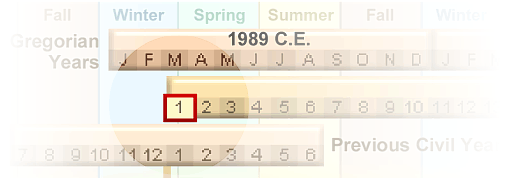
Red square showing Hebrew Month 1 selected 12 Month Spiritual Regular Year 
13 Month Spiritual Leap Year 
Civil Year This bar graphic represents the Civil Year. Numbers on this bar graphic correspond to month numbers of the overlapping Spiritual year. The Civil Year begins in the fall in Month 7 in September or October on the Gregorian calendar. The Civil Year is the offset and the complement to the Spiritual Year. The Jubilee Cycle is determined from the Civil Year which begins in Month 7 of the Spiritual Year. The fall festivals occur in Month 7 which is the first month of the Civil Year. Judean kings historically reckoned their reigns from Month 7.
Color coding helps Regular Civil Year 
Sabbatical Year 
Jubilee Year 

The Spiritual Year The corresponding Civil Year
Civil Years always begin in Gregorian Years This bar graphic represents two sequential Julian years before October 14, 1582 C.E. and two sequential Gregorian years after this date. It is labeled with letters that correspond to the Gregorian month names (J for January, F for February, etc.). All of the year bar graphics shown are precisely positioned in relation to each other and to their alignment with the seasons. The seasons are color coded, labeled and are shown in the background as part of the Month Header. 
1989 C.E. Calendar Year 1990 C.E. Next Calendar Year
Jubilee Cycle The Jubilee Cycle consists of 50 Civil Years - seven Shemittah Cycles and a Jubilee Year. A Shemittah Cycle consists of seven Civil Years where the seventh year is a Sabbatical Year. The Jubilee Cycle Timeline on the Month Header is subdivided into three rows. The top row is divided into 50 small tiles, where each tile represents a Civil Year in the Jubilee Cycle. The second row shows the seven Shemittah Cycles plus the Jubilee Year shown as the last tile on the far right. The bottom row shows the entire duration of the Jubilee Cycle. A red border enclosing one of the Civil Year tiles, indicates which Civil Year is being displayed. The seven Sabbatical years are color coded light blue, and the Jubilee Year at the right end of the bar is color coded purple. By clicking any of the 50 Civil Year tiles on this bar, you can quickly navigate to other years within the Jubilee Cycle. 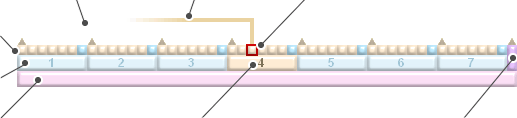
1 8 15 22 29 36 43 50
Numbered Civil Years
Line connecting the
Red border indicates which
Small tiles represent
7 year blocks known
Bar representing the
In this example, the red square is
The Jubilee Year, represented
7000 Year The complete Creation Calendar spans 7000 years. This 7000 Year Timeline is divided into 140 Jubilee Cycles. Each position on the scale represents one 50 year Jubilee Cycle. The years from creation are shown in 1000 year increments above the timeline. The Jubilee Cycles from creation are shown in 20 cycle increments below the timeline. 
Hebrew Years since creation Jubilee Cycles since creation The Ages The colored bars aligned underneath the 7000 Year Timeline represent the various ages in the 7000 Year Plan of Elohim. The Present Age is color coded turquoise. The Age of Desolation is color coded purple. The Age of Instruction is color coded orange. The world is currently in the Age of the Messiah which is color coded green. The Age of Life or the Millennial Kingdom is color coded blue. 
Back Button Click this button to go back to the previous web page from which you came. Special DaysThe Creation Calendar identifies special days such as festival days, fast days, the modern state of Israel's civil holidays and other important days using specially colored backgrounds. Below is a color key which identifies the background colors used for designating these special days. 
Ordinary Days Light tan is the default color used for common ordinary calendar days. 
Sabbaths & High Sabbaths Dark blue represents weekly Sabbaths and the seven High Sabbaths or appointed times of יהוה . According to Leviticus 23, everyone is commanded to observe and to rest on these days. 
Intermediate Festival Days Light blue represents festival days on which work is permitted. 
Minor Festival Days Purple designates minor festival days. These are festivals which are recorded in Scripture or in other historical sources. Observance of these is optional and not commanded in Scripture. 
Minor Fast Days Orange indicates minor fasts which are found in Scripture and other sources. They are shown for their historical relevance and are not commanded in Scripture. 
Minor Festival Sabbath Days This combination of blue and purple is used whenever a minor festival day occurs on a weekly Sabbath. 
Israel's Civil Holidays. Green designates the modern state of Israel's civil holidays as they appear on the Creation Calendar. Israel currently observes its civil holidays on the Rabbinic Calendar. 
Jubilee New Year This blue-green color is used to indicate the beginning of a Jubilee Year. The Jubilee Year occurs every 50 years and begins on Day 10 of Month 7, also known as Yom Kippur. 
Minor Fast Before Passover Light blue and orange is for the special case when the Fast of the Firstborn falls on the preparation day for the Passover Seder. The Passover occurs at sundown commencing Day 14 of Month 1. 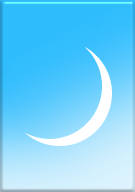
New Moon Days (can be any color) A superimposed crescent moon over any background color denotes a Rosh Chodesh in Jerusalem at sundown that day. It marks the end of the current month and the start of the next one. Equinoxes and SolsticesAn equinox is defined as the time when the apparent geocentric longitude of the sun (that is, calculated by including the effects of aberration and nutation) is either 0 degrees (the spring equinox) or 180 degrees (the fall equinox). On the day of an equinox, daytime and nighttime are approximately the same anywhere on the earth. In the northern hemisphere, the spring equinox denotes the transition from winter to spring, whereas the fall equinox marks the transition from summer to fall. The winter solstice is the shortest day of the year, and the summer solstice is the longest for observers in the northern hemisphere. The spring equinox is used to determine when the Spiritual Year begins which is the process of intercalation. Intercalation is the method of determining when to insert an extra month (a leap Month 13) in order to keep the Spiritual Year synchronized with the seasons. In an intercalated Hebrew Year, Month 12 has also been called Adar א Aleph (Adar I) and the following intercalary Month 13 has been called Adar ב Bet (Adar II). The seasons are ruled by the sun, and the spring equinox is the demarcation point for the solar cycle in the Creation Calendar. The Creation Calendar always places Day 15 of Month 1 on or after the Hebrew Day of the spring equinox. The following colors and shapes are used on the Creation Calendar for displaying the equinoxes and solstices.
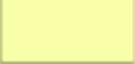
Equinox or Solstice A yellow rectangle at the bottom of a day indicates an equinox or solstice event occurs during that day. The precise time of the event is displayed inside this yellow rectangle area.

Equinox or Solstice After Sunset If an equinox or solstice event occurs after sunset in Jerusalem on the Gregorian/Julian date listed in almanacs, then a yellow triangle appears for that day. A yellow rectangle indicates the equinox or solstice event on the correct Hebrew Day. Calendar Day DetailEach day rectangle displayed in the Creation Calendar displays the Hebrew Day of the Hebrew Month, and the corresponding dates on the Gregorian/Julian calendar. Some days provide additional information. The following diagram explains possible types of information that can be shown on calendar days. 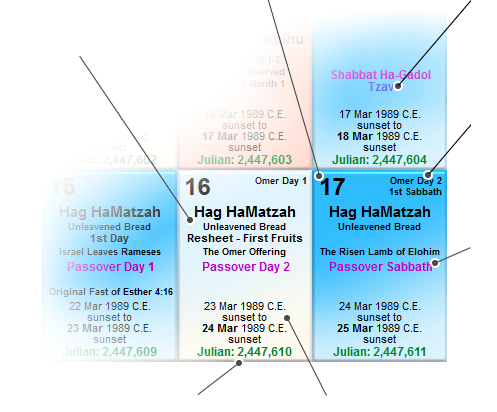
The Day Number
This is the day number Special Events
This is where the names Parashah Reading
Hebrew names in blue Additional Notes
The upper righthand Special Readings
The three middle rows can Julian Day Numbers
Julian Day Numbers are used by Gregorian / Julian Date
Hebrew days occur between The 24 Priestly CoursesWhen the sacrificial system was in operation, the Levitical priests were divided into shifts which operated on a rotation basis. These shift rotations are referred to as the priestly divisions or the sacerdotal courses. It is certain that the 24 Priestly Courses operated on a continuous 168 day cycle with 24 shifts of 7 days. 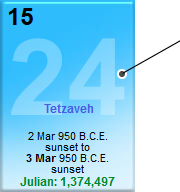
Identifying the 24 Priestly Courses During the time when the 24 Priestly Courses were operating, the Creation Calendar displays a large number on each weekly Sabbath. This number corresponds to the number of a particular Priestly Course which assumed responsibility for the temple until the next weekly Sabbath. One Course concluded its service as another assumed control in the midst of a weekly Sabbath. Numbering of the 24 Priestly Courses:
1
2 3 4
Jehoiarib
Jedaiah Harim Seorim
5
6 7 8
Malchijah
Mijamin Hakkoz Abijah
9
10 11 12
Jeshua
Shecaniah Eliashib Jakim
13
14 15 16
Huppah
Jeshebeab Bilgah Immer
17
18 19 20
Hezir
Happizzez Pethahiah Jehezekel
21
22 23 24
Jachin
Gamul Delaiah Maaziah The Calibration of the 24 Priestly Courses on the Creation CalendarAccording to 1 Chronicles 24:3-19, the 24 Priestly Courses were actually devised by King David and the High Priests Zadok II and Ahimelech II in 962 B.C.E. as can be gleaned from 2 Chronicles 8:12-14.
The 24 Priestly Courses began with Course 1 - Jehoiarib on
Yom Teruah on New Moon 7 in 951 B.C.E.
which was also on the first
day of Year 2 of Shemittah Cycle 425. Course 1 -
Jehoiarib was on duty when the First Temple burned on the Fast of Month 5
on
Day 9 / Month 5 in 593 B.C.E.
The Talmud in Arachin 11B indicates and the Creation Calendar confirms that
Course 1 - Jehoiarib was in fact on duty that week.
Figure 1: Priestly Course 1 (951 B.C.E.) 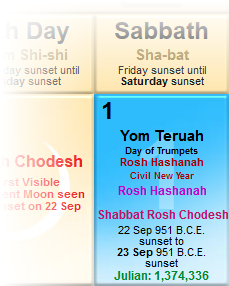
Solomon initiated the 24 Priestly Courses starting with Course 1 - Jehoiarib on New Moon 7 in 951 B.C.E. at the dedication of the First Temple as David commanded in 2 Chronicles 8:12-14. Figure 2: Priestly Course 1 (593 B.C.E.) 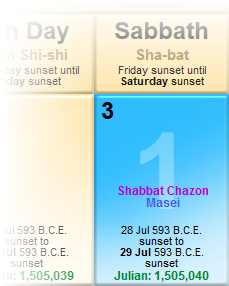
The First Temple burned between Day 7-10 of Month 5 in 593 B.C.E. according to the account in 2 Kings 25:8-9 and Jeremiah 52:12-13. Course 1 - Jehoiarib was on duty at this time according to Arachin 11B. According to Ezra 7:1-10, Ezra left Babylon on New Moon 1 in 458 B.C.E. and arrived in Jerusalem on New Moon 5 in 458 B.C.E. in Year 7 of Artaxerxes I (465-424). It is evident from Ezra 2:36-39 that of the 24 Priestly Courses which existed at the end of the First Temple Period, only 4 Priestly Courses returned in 458 B.C.E. These were: Course 9 - Jeshua; Course 16 - Immer; Course 5 - Malchijah or at least the descendents of Pashur son of Malchijah [Nehemiah 11:12]; and Course 3 - Harim. According to Ezra 6:17-18, these four priestly family lines reconstituted themselves into the 24 Priestly Divisions in order to equitably divide the tasks of performing the temple service. Josephus said in Antiquities 11 / 107-108 that sacrifices were offered at the temple dedication on Day 23 / Month 12 in 456 B.C.E. The Creation Calendar shows that Course 1 - Jehoiarib would have come on duty 1 day earlier on Day 22 / Month 12 in 456 B.C.E., at the end of Year 8 of Artaxerxes I (465-424), exactly 8 days before his Year 9 began. According to Ezra 6:19-22, the Passover was kept in Jerusalem on Day 14 / Month 1 of 456 B.C.E. and the Feast of Unleavened Bread was kept for 7 days with joy from Day 15 / Month 1 of 456 B.C.E. to Day 21 / Month 1. Josephus correctly indicates in Antiquities 11 / 109-110 that Passover was observed in Year 9 of Artaxerxes I (465-424) in the year the Second Temple was dedicated. Figure 3: Priestly Course 1 (456 B.C.E.) 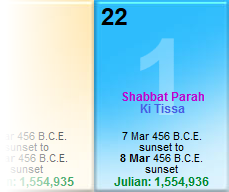
The Second Temple period appears to have begun with Course 1 - Jehoiarib which came on duty on Day 22 / Month 12 in 456 B.C.E. Josephus said in Antiquities 11 / 107-108 that the temple was dedicated and sacrifices were offered the next day on Day 23 / Month 12. Figure 4: Priestly Course 1 (445 B.C.E.) 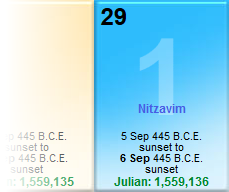
Nehemiah finished rebuilding the walls on Day 25 / Month 6 in 445 B.C.E. according to Nehemiah 6:15. Course 1 - Jehoiarib would have begun their shift on Day 29 / Month 6 and would have been on hand for the dedication of the wall on Day 1 of Month 7 in 445 B.C.E. According to Nehemiah 1:1-7, it was only 10 years later in Year 19 of Artaxerxes I (465-424), which was in 446 B.C.E. in Nehemiah's twentieth year of service to the king, that the children of Israel were in great distress for not keeping the commandments, statutes, and ordinances of Elohim. As the walls of Jerusalem were broken down and the gates were burned, the temple service obviously ceased and the 24 Priestly Courses were not able to perform their duty for some period of time. According to Nehemiah 2:1-8, it was in Year 20 of Artaxerxes I (465-424) in 445 B.C.E. that this very king decreed that the Judeans could rebuild the walls of Jerusalem, the gates, the palace and the temple. According to Nehemiah 6:15, Nehemiah rebuilt the walls in 52 days finishing on Day 25 / Month 6 in 445 B.C.E. The Levites were appointed at this time according to Nehemiah 7:1-2, and Nehemiah 12:44-47. The Creation Calendar shows that Course 1 - Jehoiarib would have begun their shift on the Sabbath on Day 29 / Month 6 in 445 B.C.E. in Year 20 of Artaxerxes I (465-424). Course 1 - Jehoiarib would have been on duty at the dedication of the wall on New Moon 7 in 445 B.C.E. For according to Nehemiah 12:32-36 and Nehemiah 12:40-42, the wall was dedicated on Yom Teruah on the Day of Trumpets on New Moon 7, exactly 6 days after the walls were finished. Figure 5: Priestly Course 8 (4 B.C.E.) 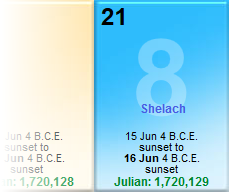
Zachariah drew the lot to burn incense in the Second Temple on Day 21 / Month 3 in 4 B.C.E. when Gabriel told him he would have a son named John. Zachariah was from Course 8 - Abijah according to Luke 1:5. Figure 6: Priestly Course 8 (28 C.E.) 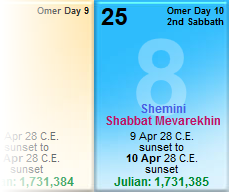
John the Immerser was 30 years old when according to Luke 1:80 he was commissioned as a Levitical priest on Day 25 / Month 1 during Course 8 - Abijah in the Second Temple. According to Acts 13:25, John finished his course on Day 3 / Month 2 in 28 C.E. According to Luke 1:5-23, Zachariah encountered the angel Gabriel during Course 8 - Abijah which was on duty from Day 21 / Month 3 to Day 28 / Month 3 in 4 B.C.E. John was conceived on New Moon 4 and he was born on New Moon 1 in 3 B.C.E. 6 months before יהושע the Messiah was born on New Moon 7 in 3 B.C.E. John the Immerser was 30 years old when he was commissioned as a Levitical priest in the Second Temple on Day 25 / Month 1 in 28 C.E. according to Luke 1:80 on the first day of Course 8 - Abijah. Just before he was stoned to death, Stephen testified of the day John was finishing his course on Day 3 / Month 2 in 28 C.E. According to Acts 13:25, John prophesied of יהושע on that day. Figure 7: Priestly Course 5 (70 C.E.) 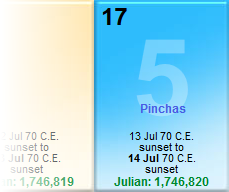
The daily sacrifice was suspended on Day 17 / Month 4 in 70 C.E. according to Josephus in Wars 6 / 93-94 and Arachin 11B. This was the last day of Course 4 - Seorim and the first day of Course 5 - Malchijah. The evidence in the Messianic Scriptures and the Babylonian Talmud suggests that the 24 Priestly Courses ran in a constant 24 week cycle of 168 days (24 X 7) from the time Solomon instituted them on New Moon 7 in 951 B.C.E. until the daily sacrifice was suspended on the Fast of Month 4 in 70 C.E. Course 4 - Seorim was finishing and Course 5 - Malchijah was scheduled to begin the day the daily sacrifice failed. The 24 Priestly Courses ran for 2217 complete cycles ending in the 2218th cycle. The Creation Calendar appears to prove that the 24 Priestly Courses, established by King David and the High Priests Zadok II and Ahimelech II, and initiated by King Solomon and the High Priest Azariah III, were faithfully observed by the Levitical priesthood for 1019 years, 10 months and 17 days. This is remarkable considering that there were at least four significant periods of time when the Temple was not operating. For more specific information on the history of 24 Priestly Courses consult the following PDF article: 
Viewing the Rosh ChodeshWhen viewing any month on the Creation Calendar, it is possible to view how the new moon appears in the evening sky in Jerusalem for either the beginning or end of the month shown. Click on the number 1 on the first day of the month to see a graphic of the new moon which begins this month. Click on the number 29 or 30 on the last day of the month to see a graphic of the new moon which ends this month. 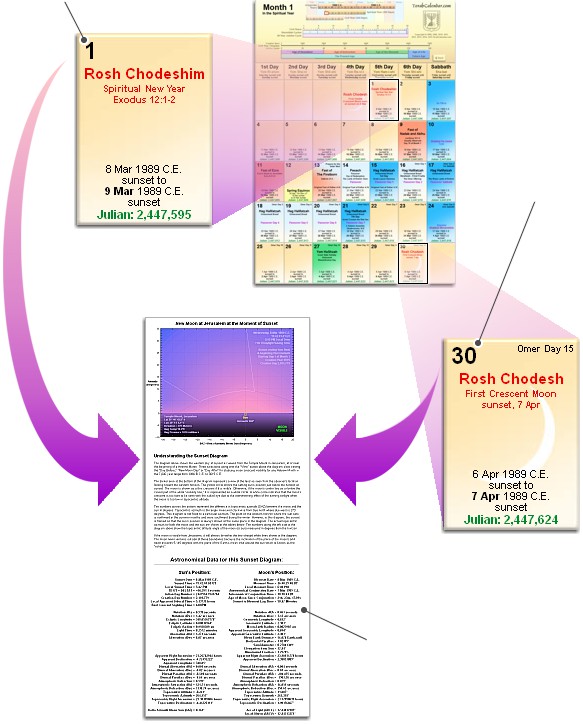
Click on this Number to
Click on this Number to All data pertaining specifically to any new moon graphic, such as sunset time, moonset time, lag time and best crescent sighting time, are displayed below the graphic and can be viewed by scrolling down. Viewing Solar and Lunar EclipsesThere are 16,645 solar eclipses and 16,874 lunar eclipses in the 7000 Year Plan of Elohim. Eclipses occur every few months and are important signs provided by Elohim. Ultimately, eclipses will allow mankind to calibrate the Scriptural 50 year Jubilee Cycle and the epoch of the Creation Calendar. When Elohim confirms the epoch of creation He will simultaneously confirm when the seventh millennium will begin.
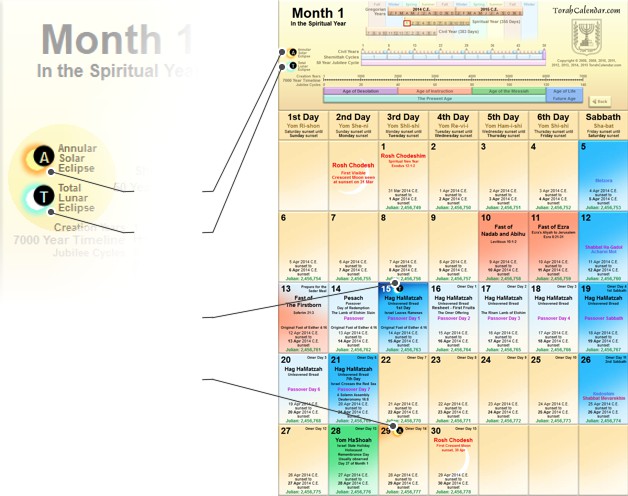
All eclipses can be viewed in the Hebrew Months
where they occur. Separate icons for solar and lunar eclipses
may be seen on the particular Hebrew Days in which they occur. The same eclipse icon is also
shown on the left side of the Month Header at the top of the Calendar page. Clicking on an eclipse icon opens the Eclipse Viewer
pop-up window where the eclipse can be studied.
Solar
Lunar
Lunar
Solar Lunar Eclipse Viewer The Eclipse Viewer pop-up window appears immediately after clicking on the Lunar Eclipse Icon. This window can be dragged around by clicking and holding down on the border to permit repositioning the Viewer window anywhere on the screen. Click the red X button in the upper right corner to close the Eclipse Viewer window. 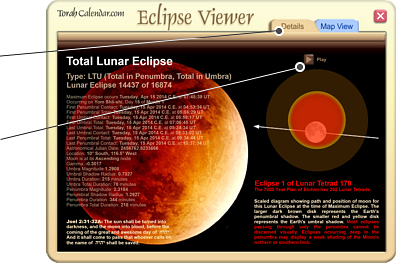
Details Tab
Play Button 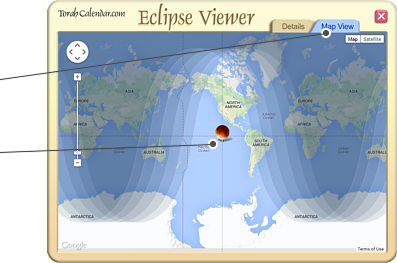
Map View Tab
Maximum Eclipse Icon Shaded zones shown on the Lunar Eclipse Map display which phase of the eclipse will be potentially visible at various geographic locations during the course of the eclipse. Lunar eclipse phases can consist of the Penumbral, Partial and Total phases. In general, the darker shaded areas see fewer phases while the lighter shaded areas see the most. The diagram in the example below is for a Total Lunar Eclipse which includes all phases. Other types of lunar eclipses may show fewer shaded areas. For example, in the case of a Penumbral Lunar Eclipse, there are only three zones displayed. 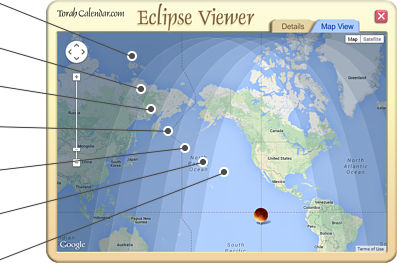
Zone 1 The eclipse cannot be seen at any time anywhere in this area. Zone 2 Viewers here only see the first contact of the Penumbral phase. Zone 3 Viewers here also see the first contact of the Partial phase. Zone 4 Viewers here also see the first contact of the Total phase. Zone 5 Viewers here also see the last contact of the Total Phase. Zone 6 Viewers here also see the last contact of the Partial phase. Zone 7 Viewers here also see the last contact of the Penumbral phase and so would see all phases of the eclipse. Solar Eclipse Viewer The Eclipse Viewer pop-up window appears immediately after clicking on the Solar Eclipse Icon. This window can be dragged around by clicking and holding down on the border to permit repositioning the Viewer window anywhere on the screen. Click the red X button in the upper right corner to close the Eclipse Viewer window. 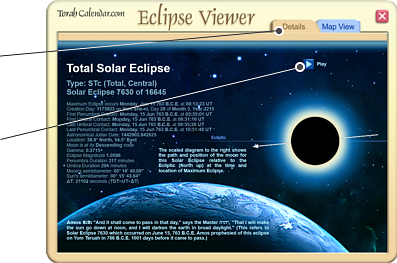
Details Tab
Play Button 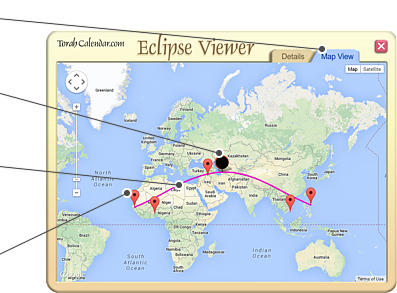
Map View Tab
Maximum Eclipse Icon
Solar Eclipse Path
Clickable Markers 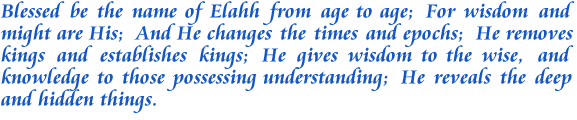
Daniel 2:20-22 
TorahCalendar.com Copyright © 2008 through 2026 All rights reserved. Duplication prohibited. Contents protected by U.S. and international copyright Laws. TorahCalendar.com grants the right for individuals to quote or make copies of any of the original materials presented at TorahCalendar.com provided that such materials are not altered in any way, retain all unaltered Copyright notices and are never used or distributed for any form of pecuniary gain or profit. |